Professional Book Editing Services
for Authors.
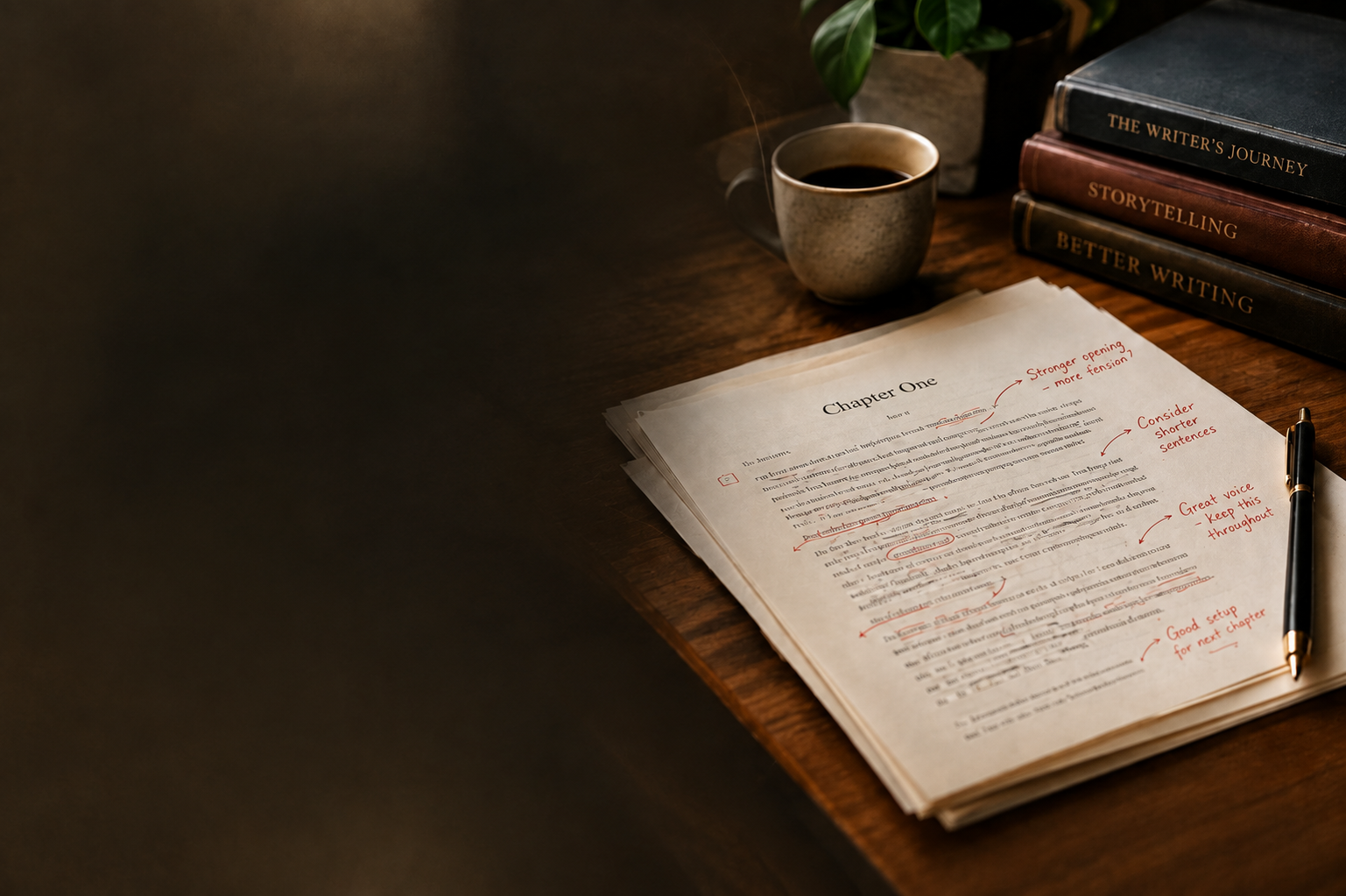
Book editing services from BookPublishersNYC.com improve a manuscript’s content, structure, language and consistency before it is formatted and published.
Professional book editing services start with the manuscript and the author’s goals. We review the manuscript, recommend the level it needs and deliver the edit for the author’s review. Not every manuscript needs every level, and the author decides which to buy.
Editing
Editing
Editing
What Are Book
Editing Services?
Book editing services are professional services that review and improve a manuscript before it is formatted and published. An editor reads the manuscript, identifies what weakens it and corrects or recommends changes. The purpose is a clearer, more consistent and more readable book that still sounds like its author.
Editing covers several different kinds of work. Some editing looks at the whole book: its structure, argument or story, and fit for its readers. Some looks at sentences: their clarity, rhythm and style. Some looks at correctness: grammar, usage, punctuation and consistency. Publishing professionals separate these into levels so that an author buys the work the manuscript actually needs.
Authors need book editing at any stage after a complete draft. A first draft often needs developmental editing. A revised manuscript may need only line editing or copy editing. Editing comes before proofreading and before formatting, because later steps work on the edited text.
Where Editing Fits in Production
Editing improves the manuscript first. Proofreading then checks the final text, and formatting lays out the approved text. Doing the steps in this order means later work does not have to be redone after the text changes.
Developmental, Line and Copy
Editing Explained.
Each level of editing answers a different question about the manuscript. The levels build on each other, from the whole book down to the details of each sentence.
Developmental editing
Does the book work as a whole?
Developmental editing, also called structural or substantive editing, evaluates the manuscript’s big-picture elements. For nonfiction, that means the argument, organization, completeness, clarity of purpose and fit for the intended reader. For fiction, it means plot, characters, pacing, point of view and the shape of the story. The editor identifies what is missing, repeated, out of order or unclear and recommends how to fix it. It is the most thorough level and suits a manuscript that has not yet been revised.
$8–$13 per 250 words
Line editing
How does the writing read?
Line editing works sentence by sentence on style, clarity, flow, word choice, tone and rhythm. It improves how the text reads while preserving the author’s voice. It suits a manuscript whose structure is sound but whose prose needs tightening or polish.
$7.50–$12.50 per 250 words
Copy editing
Is the text correct and consistent?
Copy editing corrects grammar, spelling, punctuation and usage, and it checks consistency in names, terms, capitalization, numbers and style. It also flags factual or continuity problems for the author to resolve. It suits a manuscript that is structurally and stylistically ready and needs a technical clean-up before proofreading.
$5–$7 per 250 words
The rate within each range depends on the manuscript and the agreed scope.
Request an Editing QuoteWhich Level of Editing
Does Your Manuscript Need?
The right level depends on the state of the manuscript. The table matches common situations to the level that addresses them.
| The manuscript | Start with |
|---|---|
| Is a first draft, or the structure, argument or plot is unsettled | Developmental editing |
| Has been revised, but the prose feels uneven, wordy or flat | Line editing |
| Is structurally and stylistically final but has errors and inconsistencies | Copy editing |
| Has been edited and only needs a final check before publishing | Proofreading |
Some manuscripts need more than one level. A book often goes through developmental editing, then line editing, then copy editing, then proofreading, with the author revising between stages. BookPublishersNYC.com recommends the level after reviewing the manuscript, and the quote lists each level and its rate.
Editing Fiction and
Nonfiction Manuscripts.
Fiction and nonfiction raise different editorial questions, and the genre shapes what the editor looks for.
Fiction
Fiction editing looks at plot structure, character consistency and development, pacing, point of view, dialogue, setting and continuity across the book. A copy edit also checks that details such as names, ages, timelines and places stay consistent.
Nonfiction
Nonfiction editing looks at the argument and its structure, the order and completeness of the material, clarity, terminology and consistency in how terms, figures and references appear. Memoir sits between the two and receives both kinds of attention.
A thriller, a self-help book and a business book each have different expectations for pace, tone and structure, and editing takes those expectations into account.
How Book Editing Works
The process moves from a quote to an edited manuscript that the author reviews.
-
Request a quote
The author describes the manuscript, its genre, its word count and the goals for the book.
-
Receive the quote
The quote states the recommended editing level, the rate, the number of 250-word units and the exclusions.
-
Sign the agreements
Before work beginsThe service agreement and the confidentiality agreement are signed before work begins.
-
Make the advance payment
Before work beginsThe author pays the advance stated in the agreement, and the project begins.
-
Edit the manuscript
The editor works through the manuscript at the agreed level.
-
Review the edits
The author receives the edited manuscript and reviews the changes. The author decides which changes to accept.
Typical timeline: about three weeks. The time depends on the manuscript’s length and the type and complexity of the editing. It is an estimate, not a guaranteed delivery date, and it assumes complete files, payment and approvals.
What You Provide and
What the Editor Does.
A book editing project works best when both sides know their part. The author supplies the manuscript and the decisions, and the editor supplies the editing.
What the author provides
- A complete manuscript, in the format agreed in the quote
- The genre, the intended audience and the goals for the book
- Any style preferences, terminology or reference material the editor should follow
- Review and approval of the edits
What the editor does
- Reads the manuscript and recommends the editing level
- Edits at the agreed level, within the agreed scope
- Flags questions and inconsistencies for the author to resolve
- Delivers the edited manuscript for the author’s review
The author keeps ownership of the book and makes the final decision on every change.
What’s Included in Our
Book Editing Services?
Our book editing service includes six deliverables designed around the actual needs of your manuscript. Choose the editorial support your book needs, from manuscript assessment and developmental editing to line editing, copy editing and proofreading.
Manuscript Assessment
A focused review of your manuscript’s strengths, structure, current condition and the editing level your book needs. For a deeper manuscript evaluation.
Developmental Editing
Big-picture editorial feedback focused on structure, pacing, characters or argument, chapter order and the overall development of the manuscript.
Line Editing
Sentence-level refinement that improves clarity, flow, voice and word choice while keeping the author’s intended style and meaning intact.
Copy Editing
Careful correction of grammar, punctuation, spelling, usage and consistency so the manuscript reads clearly and maintains a consistent editorial standard.
Proofreading
A final quality check for typos, missing words, punctuation issues and other leftover errors in the near-final manuscript.
Editorial Notes & Feedback
Written comments and editorial observations that explain what needs attention, what was changed where applicable, and why the recommendation may strengthen the manuscript.
Not every manuscript needs every level of editing. The appropriate editorial scope depends on your manuscript’s condition, goals, structure and the type of changes it requires.
Book Editing Services
Compared.
Book editing services fall into four distinct levels. Each level addresses a different type of editorial problem and is most useful at a different stage of manuscript development. Understanding the difference helps authors choose the right professional book editing services instead of paying for work their manuscript may not need.
| Level | Focus | When It Happens | What It Fixes | What It Does Not Fix |
|---|---|---|---|---|
| Level 01 Developmental Editing | Structure and story or argument | First, on a complete draft | Pacing, plot, characters, chapter order, weak sections, structure and overall progression. | Grammar, punctuation and final typographical errors. |
| Level 02 Line Editing | Sentences and style | After structural changes | Clarity, flow, repetition, awkward phrasing, word choice, tone and sentence-level readability. | Major story structure, chapter organization or fundamental argument problems. |
| Level 03 Copy Editing | Technical accuracy | After line editing | Grammar, punctuation, spelling, usage, capitalization and consistency. | Major plot development, structural changes or broader argument problems. |
| Level 04 Proofreading | Final errors | Last, after design and layout | Typos, missing words, stray errors and remaining surface-level issues in the final formatted book. | Rewriting, restructuring or substantial editorial development. |
Most authors need more than one level of editing. Professional book editing services generally move from larger structural decisions toward sentence, technical and final-error review so later edits do not undo earlier editorial work.
If you are researching an edit service book or comparing editorial options, the right level depends on your manuscript’s current condition, goals and the type of changes it needs.
Book Editing Rates and Cost Examples
Editing is priced per 250 manuscript words. The number of units is the manuscript’s word count divided by 250, and the rounding method is stated in the quote. The rate within each range depends on the manuscript and the agreed scope.
| Level | Rate per 250 words |
|---|---|
| Copy editing | $5–$7 |
| Line editing | $7.50–$12.50 |
| Developmental editing | $8–$13 |
Cost examples by manuscript length
The examples below apply the published ranges to three manuscript lengths. The final price is set in the quote.
| Manuscript length | Units | Copy editing | Line editing | Developmental editing |
|---|---|---|---|---|
| 50,000 words | 200 | $1,000–$1,400 | $1,500–$2,500 | $1,600–$2,600 |
| 80,000 words | 320 | $1,600–$2,240 | $2,400–$4,000 | $2,560–$4,160 |
| 100,000 words | 400 | $2,000–$2,800 | $3,000–$5,000 | $3,200–$5,200 |
The factors that place a manuscript within a range are its condition, its length, its complexity and the agreed scope. A manuscript that needs fewer changes sits lower in the range.
Editing is not included in the publishing packages and is priced separately. Compare the publishing packages.
What Is
Developmental Editing?
Developmental editing is the big-picture level of book editing. It evaluates how the whole manuscript works, rather than focusing on how individual sentences read. A developmental editor looks at the structure, progression, coherence and overall reading experience of the complete draft.
Strengthen the whole manuscript
before polishing the details.
Developmental editing examines how the major parts of a manuscript work together. The editorial focus depends on the book, but may include structure, narrative flow, pacing, character development, argument progression, repetition and sections that need to be strengthened, reduced or reorganized.
Structure & Chapter Organization
Review chapter order, section relationships, overall organization and the way the manuscript develops from beginning to end.
Plot & Narrative Flow
For fiction and memoir, examine narrative direction, chronology, scene progression, character development and continuity.
Pacing & Progression
Identify sections that may move too quickly, too slowly or unevenly within the intended reading experience.
Argument & Idea Development
For nonfiction, consider the progression of ideas, supporting material, chapter relationships and the logic of the overall argument.
Repetition, Weak Sections & Coherence
Locate repeated ideas, underdeveloped sections, missing context and places where the manuscript’s overall direction may need attention.
Developmental feedback can include an editorial letter and margin comments that identify what may need to be strengthened, cut, expanded or reordered. The goal is to give the author a clear editorial direction for the next stage of the manuscript.
Choose developmental editing when your draft is complete but you suspect structural problems or are unsure whether the manuscript is delivering what you intend. If you are not sure which editorial level your book needs, start with a manuscript critique.
What Is Line Editing?
Polished Prose.
Line editing is sentence-level refinement. It improves how your manuscript reads, line by line, while keeping your voice. The focus is on clarity, flow, rhythm, sentence structure, tone, word choice, awkward phrasing, and repetition.
Improve how the manuscript reads,
line by line.
A line editor works through the manuscript at the sentence level, refining the language without changing the author’s intended meaning or voice. Line editing sits between developmental editing and copy editing: the structure is already sound, while the prose needs greater clarity, rhythm and polish.
Clarity
Refine sentences so ideas are easier to understand without flattening the author’s individual expression.
Flow & Rhythm
Improve transitions, pacing within passages, sentence rhythm and the movement from one thought to the next.
Sentence Structure
Refine sentence construction and arrangement when wording interrupts readability or flow.
Voice & Tone
Strengthen the presentation of the prose while respecting the author’s established voice, tone and stylistic intent.
Word Choice
Identify vague, unnecessary or less effective wording and consider more precise language where appropriate.
Repetition & Awkward Phrasing
Reduce distracting repetition and refine phrases that feel forced, unclear or unnecessarily cumbersome.
Line editing should make the manuscript stronger and more readable without making it sound like someone other than the author wrote it.
Where line editing fits: developmental editing addresses structure and progression; line editing refines prose, readability, voice and flow; copy editing then focuses on language mechanics and consistency before final proofreading.
Next: Copy Editing
Copy Editing &
Proofreading.
Copy editing and proofreading are separate services. Copy editing corrects the manuscript and establishes consistent language and style. Proofreading checks the final version after the text has been designed and formatted for publication.
Copy Editing
Copy editing corrects technical language errors and applies consistent style conventions throughout the manuscript.
-
Grammar and syntax
-
Punctuation and spelling
-
Capitalization and usage
-
Consistency of names, terms and tense
-
Style conventions
Proofreading
Proofreading is the last check before publication. It takes place after the text has been designed and formatted, focusing on remaining text-level and presentation inconsistencies.
-
Typos
-
Remaining punctuation errors
-
Formatting inconsistencies
-
Repeated or missing words
-
Final text-level checks
Copy editing works on the manuscript itself. Proofreading checks the final formatted version. They address different stages of the editorial and publishing process.
For the complete scope, workflow and considerations, read more on our dedicated Proofreading Service Page page.
Explore The Service
Editing That Protects Your Voice, Clarity &
Consistency.
A good book editing service improves your manuscript without replacing your style. The goal is to strengthen the writing, clarify the meaning and maintain consistency while keeping the author’s voice at the center of the work.
Voice &
Consistency
The Author’s Voice
Style / Clarity / Consistency
Strengthen the writing without replacing the author.
Professional book editing services should make a manuscript clearer and more consistent while preserving the qualities that make the author’s writing distinctive.
Preserving Your Voice
Editing strengthens your writing without flattening it. We work to preserve your rhythm, vocabulary, tone and distinctive way of expressing ideas.
Improving Clarity
We refine unclear sentences, repetition and awkward construction so readers can follow your meaning without unnecessary friction.
Consistency Across the Manuscript
Names, terminology, capitalization, spelling, tense and style choices are reviewed across the manuscript so the writing remains consistent from the first page to the last.
Author Review & Editorial Control
You see every change. You can accept, reject or discuss each edit, and the final editorial decisions remain with you.
Your voice remains yours. Editorial changes are intended to support the manuscript, not replace the author’s style or creative decisions.
See How Our Book Editing Service
Works on a Manuscript.
The examples below illustrate common editorial work, including sentence-level refinement, tracked changes, editor comments, and manuscript-wide style consistency. These are illustrative examples rather than client work.
Illustrative editorial examples. These examples are created to demonstrate the type of editorial work involved. Client manuscripts or screenshots should only be published when the work is genuine and the author has given permission to share it.
Before & After
A sentence can contain the right idea but still benefit from clearer construction, stronger rhythm, or the removal of unnecessary repetition.
The author was very surprised because the room was much quieter than she had expected it to be, and this made her feel nervous.
The room was quieter than she expected, and the silence made her nervous.
Tracked Changes
Tracked changes make editorial decisions visible so the author can review individual additions, deletions and wording changes before accepting or rejecting them.
She quickly ran hurried toward the station before the doors closed.
The decision was very difficult and hard to make difficult to make under pressure.
He looked at the clock and realized that he was already late.
Editor Comment
Editorial comments can identify a larger issue without rewriting the author’s work, giving the author context for a suggested structural or stylistic decision.
Consider clarifying the connection between these two paragraphs so the reader understands why the character changes direction here.
Editorial Style Sheet
A style sheet records recurring editorial decisions so names, terminology, capitalization, spelling and other style choices remain consistent throughout the manuscript.
Style decisions should follow a defined editorial framework.
Depending on the manuscript and project requirements, editorial work may reference established style and usage guidance alongside the author’s preferred conventions.
Editing vs Proofreading.
Editing and proofreading serve different purposes in the publishing process. Editing works more deeply within the manuscript, while proofreading focuses on the final or near-final text for remaining surface-level errors and consistency issues.
Book Editing
Editing examines the manuscript at an appropriate editorial level, from larger structural considerations through prose, language, clarity, and consistency.
Book Proofreading
Proofreading takes place after substantive editorial work, checking the final or near-final text for remaining errors, consistency issues, and other surface-level problems.
Where the Two Services Differ
Questions Authors
Ask Before Editing.
Clear answers about editing levels, manuscript preparation, author review, pricing, timelines, formatting, and how professional book editing services fit into the wider publishing process.
A book editing service can include manuscript assessment, developmental editing, line editing, copy editing, proofreading, and editorial feedback.
The appropriate combination depends on the manuscript. Authors choose the editorial levels their book actually needs.
Developmental editing focuses on the larger manuscript, including structure, pacing, organization, narrative development, and ideas.
Line editing works at the sentence and paragraph level, refining flow, clarity, word choice, tone, and readability.
Yes. Copy editing addresses grammar, punctuation, spelling, usage, terminology, and consistency.
Proofreading is the later-stage check for remaining errors after the substantive editorial work has been completed.
For more detail, see our Book Proofreading service.
Professional editing is generally most useful after you have completed a substantial draft and before final design and formatting.
Proofreading comes later, after the book’s substantive editorial and layout work has been completed.
Yes. We provide editorial support for fiction, nonfiction, memoir, poetry, and children’s books.
Editorial priorities vary by manuscript type. Fiction may require attention to pacing, characters, dialogue, and narrative structure, while nonfiction may require attention to argument, organization, terminology, and clarity.
The goal of editorial work is to improve the manuscript while respecting the author’s intended voice, tone, and purpose.
Authors remain involved in editorial decisions and can review, discuss, accept, modify, or decline suggested changes.
Yes. Author review is part of collaborative editorial work. You can review changes, comments, questions, and recommendations before making your final decisions.
This allows the editing process to remain aligned with your intended meaning and creative direction.
Book editing services are priced according to project scope rather than a single flat rate.
Pricing depends on factors such as word count, manuscript condition, editing level, complexity, manuscript type, and the amount of editorial work required. Additional proofreading or editorial support can also affect the scope.
We confirm the project scope and quote before work begins.
Editing timelines depend primarily on manuscript length, condition, and the editing level required.
The expected schedule is confirmed as part of the project scope rather than applying one fixed timeline to every manuscript.
Yes. Authors can work with editors remotely through shared documents, tracked changes, comments, and scheduled consultations.
The editing process can therefore be coordinated without requiring authors to be physically present.
Substantive editing is generally best completed before final book formatting. Major text changes after formatting can affect page breaks, pagination, contents pages, and other layout elements.
Once the editorial stage is complete, the manuscript can move into book design and formatting with greater stability.
Learn more about Book Formatting.
The depth of review, editing level, deliverables, and project schedule depend on the manuscript and agreed scope. A manuscript assessment or consultation can help determine the most appropriate editorial path.
Request an Editing Consultation
Ready for Professional
Book Editing Services?
Tell us about your manuscript, and we will recommend the editing level, scope and next step. Start with a free consultation and provide only the project details you already know.
Start with your manuscript, not a fixed package.
Book editing services are shaped by the condition, structure and requirements of each manuscript. These details help us understand the editorial work your project may require.